INTRODUCTION

WHAT?
Wondering what is digital marketing exactly? It refers to the use of Digital Channels, Platforms and Technologies to promote products, Services or brands to consumers.
With the huge growth of the internet and the widespread use of smart phones, business have shifted from traditional marketing methods to online strategies
WHERE?
Digital Marketing is done on the internet and digital platforms where people spend their time.
Main places where digital marketing happens are-
- Search Engines
- Social Media Platforms
- Websites and Blogs
HOW?
Digital Marketing is done by Planning, Creating Content, Promoting it online, and Improving based on results.
STEP BY STEP EXPLANATION
- Set a Goal
- Identify Your Target Audience
- Choose The Right Platforms
- Create Content
- Use Marketing Methods
- Engage With Audience
- Track Performance
- Improve And Optimize
BENEFITS OF DIGITAL MARKETING
Digital Marketing offers a wide range of benefits for businesses of all sizes.
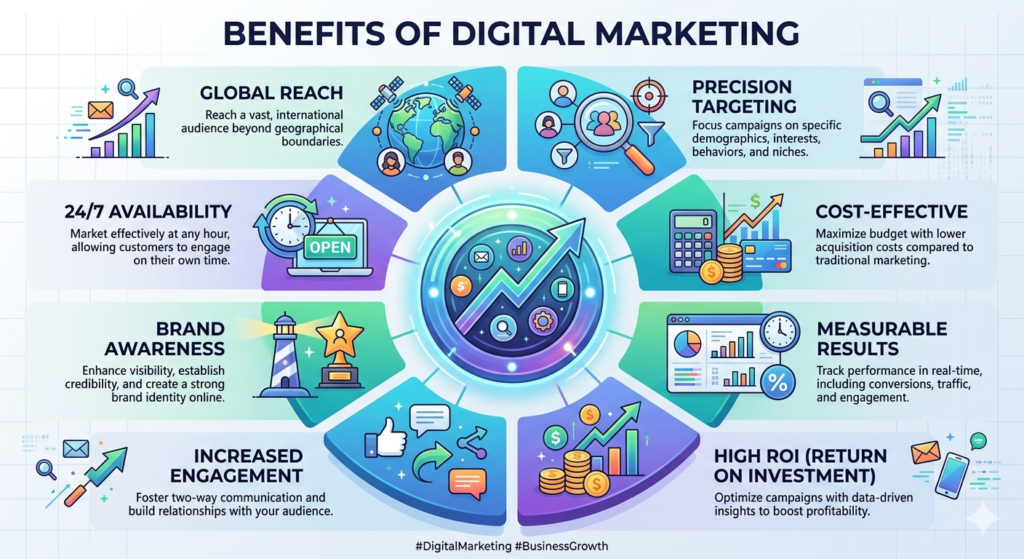
1)Global Reach-
With Digital Marketing you can reach audiences worldwide, unlike traditional methods that are often limited to local areas.
2)Cost Effective-
It is much cheaper than traditional advertising.Even small businesses can run campaigns on a limited budget.
3)Targeted Audience-
You can target a group of people based on age, location, interests, behaviour and ensuring your message reaches the right people.
4)Measurable Results-
Tools like Google Analytics and social media insights allow you to track performance in real time( Clicks, Conversions, Traffic, etc.)
5)Flexibility and Adaptability-
Campaigns can be adjusted instantly based on performance-pause ads, change content, or shift strategies quickly.
TYPES OF DIGITAL MARKETING
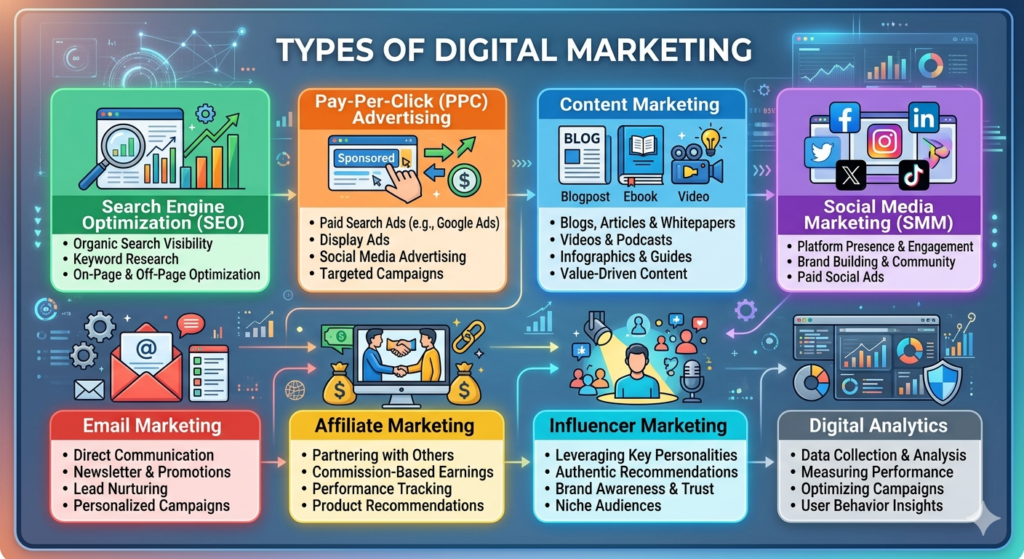
- SEARCH ENGINE OPTIMIZATION (SEO)
It is the practice of optimizing your website and content to rank higher in search engine results for relevant keywords. It is best for long term traffic.
- SOCIAL MEDIA MARKETING
It involves creating and sharing content on social platforms to achieve marketing goals.This includes organic posts, paid advertising and influencer partnerships across platforms like facebook, instagram, linkedin, Twitter and more. It is best for brand awareness.
- CONTENT MARKETING
Content Marketing is creating and distributing valuable, relevant content to attract and engage a target audience. It provides genuine value rather than directly promoting products. It is best for Authority building.
- EMAIL MARKETING
Email marketing involves sending targeted messages to a list of subscribers who have opted in to receive communications from your business. It is best for Retention/Nurturing.
- SEARCH ENGINE MARKETING (SEM)
It is a digital marketing strategy used to increase a website’s visibility on search engine results pages(SERPs) primarily through paid advertising.
CHALLENGES IN DIGITAL MARKETING

- DATA PRIVACY AND REGULATION
Strict privacy laws and the removal of third party cookies make targeting and tracking user behaviour more difficult.
- ADAPTING TO ALGORITHM CHANGES
Frequent changes to search engine and social media algorithms affect content performance, forcing marketers to constantly update strategies.
- TARGETING THE RIGHT AUDIENCE
Identifying and reaching a specific audience is a foundational challenge because target demographics are often fragmented across multiple personas and platforms.
- MANAGING MULTIPLE CHANNELS
Maintaining consistent brand messaging and a seamless user experience across social media, email and websites is a daunting task that can strain small teams.
MOST COMMON EXAMPLES OF DIGITAL MARKETING
1.SEARCH ENGINE OPTIMIZATION(SEO)
SEO is the process of optimizing your website to “rank” higher in search engine results pages (like Google or Bing), thereby increasing the amount of organic (free) traffic your website receives.
- Examples: Researching and using specific keywords in a blog post, optimizing website loading speed, or earning backlinks from other reputable websites.
2.SEARCH ENGINE MARKETING(SEM) & PAY-PER-CLICK (PPC)
Unlike SEO, SEM involves paying for your website to appear at the top of search results or on other websites. You pay a fee each time your ad is clicked.
- Examples: Google Ads (those sponsored results at the top of your Google search), promoted tweets on X (Twitter), or sponsored messages on LinkedIn.e
3. SOCIAL MEDIA MARKETING
This involves promoting your brand and your content on social media channels to increase brand awareness, drive traffic, and generate leads for your business.
- Examples: Running a targeted Facebook ad campaign, posting engaging TikToks or Instagram Reels, or hosting a live Q&A session on LinkedIn.
4. CONTENT MARKETING
This focuses on creating and distributing valuable, relevant, and consistent content to attract and retain a clearly defined audience. The goal is to drive profitable customer action without explicitly pitching a product.
- Examples: Publishing educational blog articles, creating downloadable eBooks or whitepapers, or producing an industry-specific podcast.
5. EMAIL MARKETING
Companies use email marketing as a way of communicating with their audiences. Email is often used to promote content, discounts, and events, as well as to direct people toward the business’s website.
- Examples: A weekly newsletter sent to subscribers, a welcome email series for new customers, or “abandoned cart” reminders for an e-commerce store.
6. INFLUENCER MARKETING
Similar to affiliate marketing, this involves partnering with influencers—people with a large, engaged following—to promote your brand to their audience.
- Examples: Sponsoring an Instagram model to wear your clothing brand, or paying a tech YouTuber to review your new software.
CONCLUSION
You don’t need a massive budget to win at digital marketing;you need a consistent strategy.Whether you’re optimizing for ‘zero click’ search or launching your first influencer campaign, the most important step is simply to start and iterate based on your own data.
Ready to scale? Book a FREE 15-MINUTE AUDIT with our team today, and let’s identify the biggest “quick wins” currently hidden in your marketing funnel.
FAQS
1) IS DIGITAL MARKETING A GOOD CAREER?
Yes,digital marketing is considered a strong career choice for 2026, offering high demand, flexibility, and a relatively low barrier to entry, competitive salaries and diverse paths.
2) DIGITAL MARKETING IN SHORT ANSWER
Digital marketing works through three main pillars that help a business grow online
- Lead Generation (Getting Attention)
- Engagement (Building Trust)
- Conversion (Making Sales)
3) WHY IS DIGITAL MARKETING IMPORTANT TODAY?
1. Your Audience Is Already There (And Searching)
With over 5.4 billion people online globally, the customer journey is now completely digital-first. Whether they are looking for a local coffee shop or enterprise software, people search Google, ask AI assistants, check YouTube for reviews, and compare prices online before ever pulling out their wallets. If your business doesn’t have a strong, trustworthy digital footprint across these touchpoints, you are essentially invisible.
2. Zero Wasted Spend: Hyper-Precise Targeting
Traditional advertising (like billboards, print, or TV) is the “spray and pray” approach—you pay a premium hoping the right person happens to look up. Digital marketing allows for laser-focused targeting. You can put your product directly in front of people based on their exact age, location, browsing behavior, job title, and even recent search history. You only pay to reach the people who are actually primed to convert.
3. Total Measurability and Clear ROI
Digital marketing provides hard, undeniable data. Every single click, view, lead, and sale can be tracked in real-time. You know exactly which ad drove a purchase, which email subject line got the most opens, and which webpage is losing customers. This allows businesses to kill what isn’t working, scale what is, and get a significantly higher Return on Investment (ROI) compared to traditional media.
4. The AI and Search Evolution
We are no longer just optimizing for standard blue links. The rise of AI overviews (like ChatGPT, Perplexity, and Google’s AI summaries) means users get direct answers to their queries. Digital marketing now incorporates Generative Engine Optimization (GEO)—structuring and creating high-quality content so that AI systems recognize your brand as the authoritative answer. If you aren’t actively managing how AI and search engines perceive your business, your competitors will take your spot.
5. It Levels the Playing Field
In the past, massive corporations dominated because they could outspend smaller businesses on mass media. Digital marketing democratizes growth. A local startup or a solo entrepreneur with a clever social media strategy, highly engaging short-form video content, and a well-optimized, modest ad budget can successfully outmaneuver a massive, sluggish corporation.
6. Building Relationships, Not Just Transactions
Digital marketing isn’t just about hard selling; it’s about building an owned community. Through targeted email marketing, direct social media interaction, and valuable content, businesses can build trust and brand loyalty over time. Customers expect personalization today, and digital channels allow you to speak directly to them, turning one-off buyers into long-term advocates.